
AI Spreadsheet vs ChatGPT for Data Analysis: What Actually Works
ChatGPT is excellent for one-off questions. AI spreadsheets are built for ongoing analysis. They're not the same thing — and understanding the difference saves you significant time and money.

Andrew Grosser
June 1, 2026 • 10 min read
The question 'should I use ChatGPT or an AI spreadsheet for data analysis?' is one of the most common we hear. The answer depends entirely on what you're doing. ChatGPT is a conversational AI that excels at one-off explanations, quick calculations, and exploratory questions. An AI spreadsheet like Sourcetable is a persistent analysis platform built for ongoing financial work, large datasets, and analysis that compounds over time. This guide covers when each wins — honestly.
Quick Comparison
| Capability | ChatGPT | Sourcetable AI Spreadsheet |
|---|---|---|
| Finance benchmark | Not tested (GPT-4) | 100% (Vals.ai) |
| Analysis persistence | ❌ Ephemeral | ✅ Permanent |
| Data connections | ❌ File uploads only | ✅ 500+ live APIs |
| Dataset size | ❌ ~100MB limit | ✅ 1 billion rows |
| Auto data refresh | ❌ Manual re-upload | ✅ Daily auto-refresh |
| Trading execution | ❌ No | ✅ Robinhood |
| Financial tools | ❌ General purpose | ✅ 500+ built-in APIs, Monte Carlo |
| Cost | $20/mo (Plus) | Team pricing |
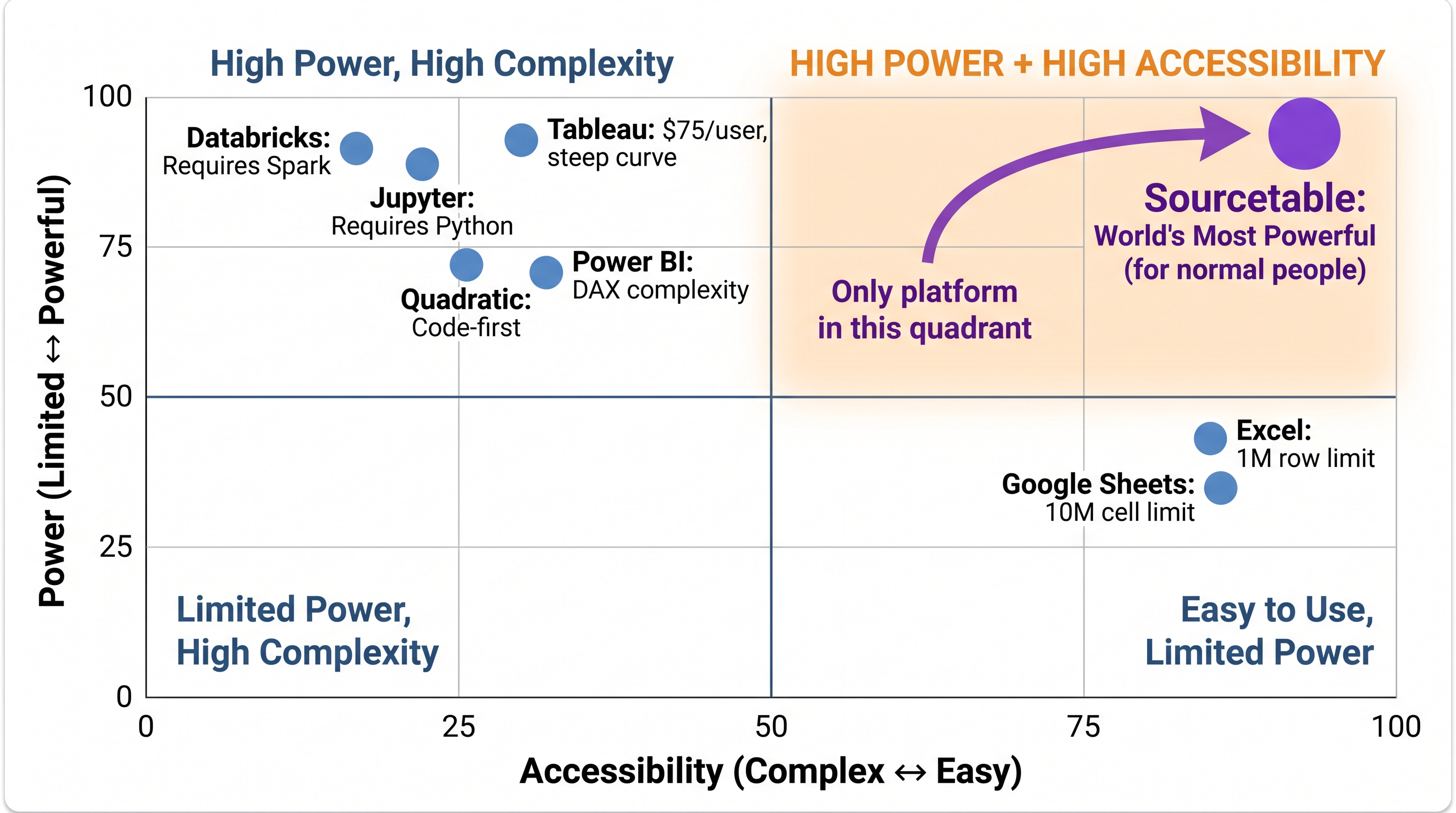
Sourcetable is the only analytical platform in the High Power + High Accessibility quadrant. Every competitor trades one for the other.
Where ChatGPT Genuinely Wins
ChatGPT is exceptional for: explaining complex financial concepts ('explain how duration affects bond prices when rates rise'), writing and debugging code, drafting analysis narratives from data you paste in, and quick one-off calculations that don't need to be saved. If you have a specific question and don't need the answer to persist or auto-update — ChatGPT is fast and capable. The GPT-4 model is genuinely impressive on finance questions in isolation.
The Benchmark Gap
On the Vals.ai finance agent benchmark — standardized financial analysis tasks — Sourcetable scored 100%. Claude Opus 4.5 scored 67%. OpenAI's GPT-4 wasn't in the benchmark, but the 33-point gap between Claude and Sourcetable reflects the difference between a general-purpose LLM and a platform purpose-built for financial analysis. Domain-specific infrastructure (500+ data APIs, institutional analysis frameworks, pre-built financial models) produces better finance results than raw model capability alone.
The Persistence Problem
This is the fundamental difference. ChatGPT operates in sessions — each conversation starts fresh. Upload a CSV with your portfolio holdings. Explain the columns. Get analysis. Tomorrow? Start over. Re-upload. Re-explain. Every time. Sourcetable is a persistent platform: your data connections are established once and auto-refresh daily, your analysis builds on previous sessions, and your institutional knowledge compounds. For ongoing analysis work — which is most financial analysis — the productivity difference is enormous.
Data Scale: 100MB vs 1 Billion Rows
ChatGPT's file upload limit is approximately 100MB. Sourcetable's data lake queries 1 billion rows in seconds using client-side processing. For intraday tick data, full transaction histories, or large financial datasets — ChatGPT hits a hard wall. Sourcetable handles these natively without cloud infrastructure costs.
When to Use Each
Use ChatGPT for:
- ✅ Quick explanations of financial concepts
- ✅ One-off calculations you don't need to save
- ✅ Drafting narratives from data you paste in
- ✅ Code generation and debugging
- ✅ Research questions with no data component
When Sourcetable Wins
Use Sourcetable for:
- ✅ Ongoing financial analysis that builds over time
- ✅ Live data from 500+ APIs (Bloomberg, Refinitiv, FRED)
- ✅ Datasets larger than 100MB
- ✅ Analysis that auto-updates daily without re-uploading
- ✅ Trading execution from your analysis
- ✅ Institutional tools: DCF, Monte Carlo, backtesting, factor models
- ✅ Team analysis with shared persistent context
See for yourself why analysts choose Sourcetable over Ai Spreadsheet Vs Chatgpt Data Analysis
100% benchmark scores. 500+ financial APIs. Free to try.
Start Free Trial →