

Optimize Trading Performance with Data-Driven Analytics
Evaluate trading strategies, measure risk-adjusted returns, and identify performance drivers with AI-powered analytics. Calculate Sharpe ratios, track drawdowns, analyze alpha/beta, and optimize portfolio allocation—transforming trade data into actionable insights.
Turn Trading Data Into Strategic Advantage
Trade performance analytics applies quantitative methods to evaluate trading strategies, measure risk-adjusted returns, and optimize portfolio decisions. From professional fund managers to individual traders, performance analytics transforms raw trade data into insights that drive better risk management, strategy refinement, and capital allocation decisions.
Traditional trade analysis relies on spreadsheets filled with complex formulas—Sharpe ratio calculations, drawdown tracking, correlation matrices. Traders spend hours updating metrics, generating reports, and trying to identify patterns. This manual approach is time-consuming, error-prone, and limits how deeply you can analyze performance.
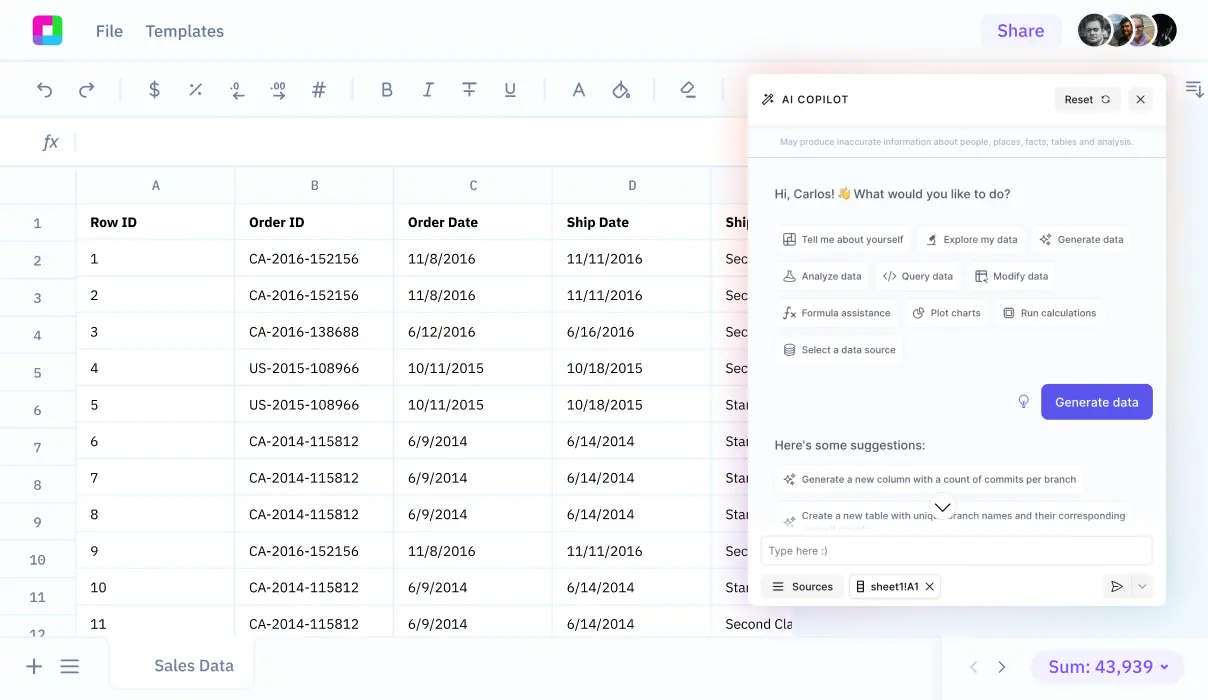
Sourcetable brings AI-powered analytics to trading performance evaluation. Import trade histories from brokers or trading platforms, then use natural language to calculate risk metrics, analyze strategy performance, identify profitable patterns, and optimize portfolio allocations. Focus on making better trading decisions rather than wrestling with spreadsheet formulas.
Why Trade Performance Analytics Matters
Trade Performance Analytics Matters
Measure Risk-Adjusted Returns
Calculate Sharpe ratio, Sortino ratio, and Calmar ratio to evaluate returns relative to risk taken. Understand whether outperformance came from skill or excessive risk-taking. Compare strategies fairly by adjusting for their different risk profiles.
Identify Strategy Strengths and Weaknesses
Analyze performance across market conditions, asset classes, and time periods. Discover which strategies work in trending vs. ranging markets, how performance varies by sector, and when your approach outperforms or underperforms.
Optimize Position Sizing and Allocation
Use quantitative methods like Kelly Criterion or mean-variance optimization to determine optimal position sizes. Balance risk and return across portfolio components. Avoid over-concentration in single positions or correlated assets.
Track Drawdowns and Recovery
Monitor maximum drawdown—the peak-to-trough decline during a losing streak. Understand drawdown duration and recovery time. Set risk limits based on tolerable drawdown levels. Detect when strategies enter unfavorable conditions.
Trade Performance Analytics Applications
Real-world applications and use cases
Hedge Fund Performance Reporting
Generate monthly performance tearsheets for investors showing returns, risk metrics, attribution analysis, and benchmark comparisons. Calculate performance fees based on high-water marks. Track fund-level and strategy-level performance separately.
Algorithmic Trading Strategy Evaluation
Backtest trading algorithms and analyze their historical performance. Calculate win rates, profit factors, and risk-reward ratios. Identify overfitting through walk-forward analysis. Compare multiple strategy variations systematically.
Prop Trading Desk Monitoring
Track individual trader performance across prop trading operations. Identify top performers and struggling traders. Allocate capital based on track records. Ensure firm-wide risk limits aren't breached through position monitoring.
Retail Trading Strategy Refinement
Analyze personal trading history to identify winning and losing patterns. Track performance by time of day, day of week, or market conditions. Calculate if trading costs (commissions, slippage) are eroding returns. Measure improvement over time.
Trade Performance Analytics Workflow in Sourcetable
Step-by-step workflow guide
Import Trade Data
Connect to brokerage platforms, upload CSV exports, or manually enter trade details. Sourcetable handles data from all major trading platforms and formats—equities, options, futures, forex, crypto. Automatically structures entries, exits, P&L, and positions.
Calculate Performance Metrics
AI computes total return, annualized return, volatility, maximum drawdown, and other key performance indicators. Calculate risk-adjusted metrics like Sharpe and Sortino ratios. Track cumulative returns over time with equity curves.
Analyze Trade Statistics
Examine win rate, average win/loss, profit factor, and risk-reward ratios. Identify your most profitable trades, biggest losses, and average holding periods. Understand the statistical distribution of your returns.
Benchmark Performance
Compare returns against relevant benchmarks—S&P 500 for equities, Russell 2000 for small caps, or custom peer groups. Calculate alpha (excess returns), beta (market sensitivity), and correlation with indices.
Essential Trade Performance Metrics
Total Return and Annualized Return
Total return measures overall gain or loss as a percentage of initial capital. Annualized return converts this to a per-year equivalent, enabling fair comparison across different time periods. Use CAGR (compound annual growth rate) for multi-year periods to account for compounding.
Sharpe Ratio
The Sharpe ratio measures excess return per unit of volatility: (Return - Risk-Free Rate) / Standard Deviation. Ratios above 1.0 indicate good risk-adjusted performance; above 2.0 is excellent. Higher Sharpe ratios mean more return for each unit of risk taken.
Sortino Ratio
Similar to Sharpe but only penalizes downside volatility, not total volatility. Better for strategies where upside volatility (good for investors) shouldn't reduce the metric. Calculated as (Return - Target) / Downside Deviation.
Maximum Drawdown
The largest peak-to-trough decline in portfolio value. Critical for risk management—drawdowns of 20% require 25% gains to recover; 50% drawdowns need 100% returns to break even. Track both percentage and duration of drawdowns.
Win Rate and Profit Factor
Win rate is the percentage of profitable trades. Profit factor is gross profits divided by gross losses. A profit factor above 2.0 indicates strong performance. You can be profitable with low win rates if winners are large, or high win rates if losers are small.
Alpha and Beta
Alpha measures excess returns above a benchmark after adjusting for risk. Beta measures sensitivity to benchmark movements. A beta of 1.0 means the strategy moves in line with the benchmark. Positive alpha indicates skill; beta indicates market exposure.
Calmar Ratio
Annualized return divided by maximum drawdown. Focuses on tail risk—strategies with similar returns but lower max drawdowns score higher. Particularly relevant for investors who prioritize capital preservation during market stress.
Portfolio Optimization Techniques
Mean-Variance Optimization
Markowitz's modern portfolio theory finds allocations on the efficient frontier—maximizing expected return for given risk, or minimizing risk for given return. Requires expected returns, volatilities, and correlations. Sensitive to input estimation errors, so use robust methods or resampling.
Kelly Criterion
Calculates optimal position size to maximize long-term growth rate. Kelly % = (Win Rate × Average Win - Loss Rate × Average Loss) / Average Win. Many traders use fractional Kelly (e.g., half Kelly) to reduce volatility. Most useful when you have reliable win/loss statistics.
Risk Parity
Allocates capital such that each asset contributes equally to portfolio risk rather than equal dollar amounts. Typically requires leverage on low-volatility assets. Aims for better diversification than market-cap weighting or equal weighting.
Black-Litterman Model
Combines market equilibrium returns with investor views to generate expected returns for optimization. Reduces estimation error vs. pure mean-variance. Allows expressing confidence in views—strongly held views influence allocations more.
Factor-Based Allocation
Allocate across risk factors (value, momentum, quality, size, volatility) rather than individual securities. Factor exposures tend to be more stable than individual security characteristics. Enables systematic portfolio construction and risk budgeting.
Frequently Asked Questions
What's the minimum trade history needed for meaningful performance analysis?
For basic metrics like total return and drawdown, even a few months suffice. For statistical reliability on risk-adjusted metrics like Sharpe ratio, aim for 1-3 years of data or 100+ trades. Longer histories provide more confidence in metric estimates, but start analyzing immediately—early insights often reveal obvious improvements.
How do I account for costs in performance calculations?
Include all costs: commissions, bid-ask spreads (slippage), financing charges for margin, and taxes. Net returns after all costs are what matters for real performance. Track cost ratios (costs/gross P&L) to identify if trading costs are excessive. High-frequency strategies are especially sensitive to transaction costs.
Should I use arithmetic or geometric returns for multi-period analysis?
Use arithmetic mean for short periods or averaging across securities. Use geometric mean (CAGR) for multi-period returns since it accounts for compounding. Geometric returns are always lower than arithmetic returns due to volatility drag. For portfolio construction, geometric returns reflect actual wealth growth.
How do I compare strategies with different holding periods?
Annualize all returns and metrics for fair comparison. Use annualized volatility, Sharpe ratios, and returns. Be aware that intraday strategies may show artificially high Sharpe ratios due to holding-period effects. Consider transaction costs—short-holding strategies incur more costs per dollar of capital.
What Sharpe ratio is considered good?
Above 1.0 is good, above 2.0 is very good, above 3.0 is exceptional (and rare outside high-frequency trading). Context matters: managed futures often have Sharpe ratios of 0.5-1.0, while market-neutral strategies target 1.5-2.5. Compare to peers in your strategy category rather than absolute thresholds.
How often should I recalculate performance metrics?
Calculate daily or weekly for active monitoring of current positions and risk exposure. Generate monthly reports for consistent performance tracking. Run comprehensive analyses quarterly or semi-annually to assess strategic performance and make allocation adjustments. Real-time for professional trading operations.
Related Analysis Guides
Connect your most-used data sources and tools to Sourcetable for seamless analysis.
Frequently Asked Questions
If your question is not covered here, you can contact our team.
Contact UsHow do I analyze data?
What data sources are supported?
What data science tools are available?
Can I analyze spreadsheets with multiple tabs?
Can I generate data visualizations?
What is the maximum file size?
Is this free?
Is there a discount for students, professors, or teachers?
Is Sourcetable programmable?

Ready to Optimize Trading Performance?
Join traders and portfolio managers using AI-powered analytics to improve risk-adjusted returns and refine trading strategies. Start analyzing trade performance today.