

Master Meta-Analysis with AI-Powered Statistical Methods
Synthesize research findings across multiple studies with rigorous statistical methods. Calculate pooled effect sizes, assess heterogeneity, detect publication bias, and generate publication-ready forest plots—all with AI assistance that ensures methodological rigor.
Transform Research Synthesis with Statistical Meta-Analysis
Meta-analysis applies quantitative methods to synthesize findings across multiple studies, generating more precise estimates than any single study can provide. By pooling effect sizes from independent investigations, meta-analysis increases statistical power, resolves conflicting results, and identifies patterns invisible in individual studies. It's the gold standard for evidence synthesis in medicine, psychology, education, and social sciences.
Traditional meta-analysis requires specialized software—RevMan, Comprehensive Meta-Analysis, or R packages—plus deep statistical expertise. Researchers spend weeks calculating effect sizes, testing for heterogeneity, and creating forest plots. This complexity limits who can conduct meta-analyses and slows the pace of evidence synthesis.
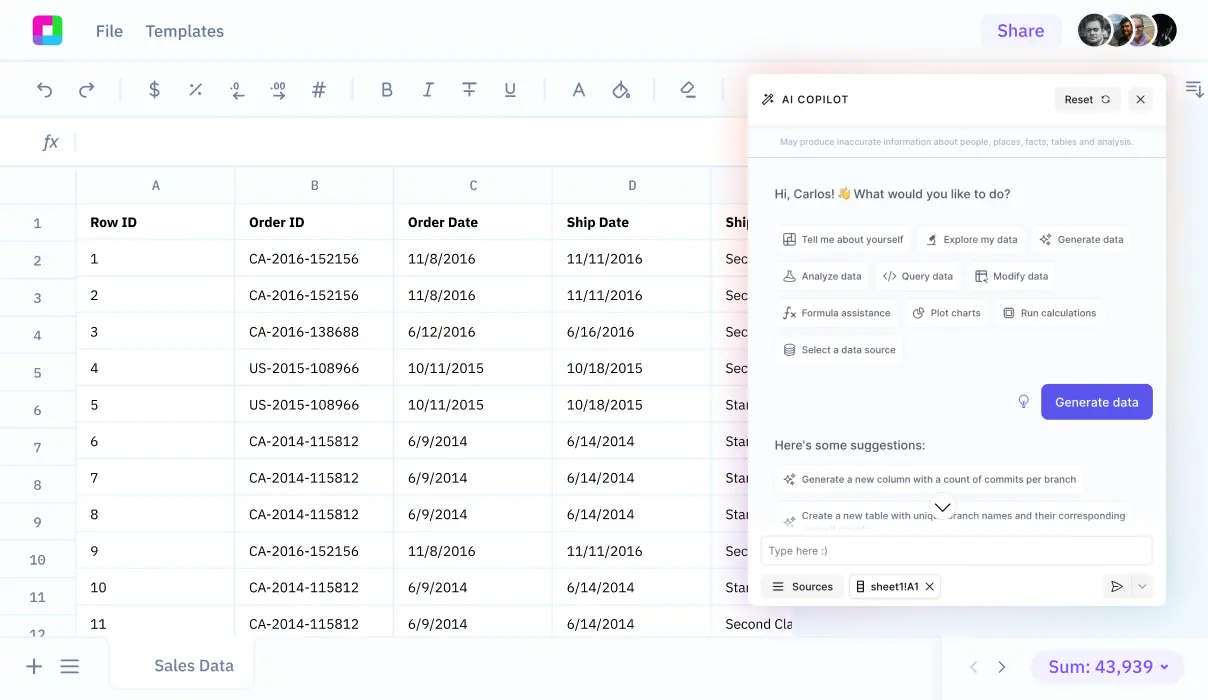
Sourcetable democratizes meta-analysis with AI-powered assistance. Import study data, let AI calculate appropriate effect sizes (Cohen's d, odds ratios, risk ratios), assess between-study heterogeneity, detect publication bias, and generate publication-ready visualizations. Focus on interpreting findings rather than wrestling with statistical computations.
Why Use AI-Powered Meta-Analysis Methods
Use AI-Powered Meta-Analysis Methods
Automated Effect Size Calculation
Calculate standardized mean differences (SMD), odds ratios, risk ratios, and correlation coefficients automatically. AI selects appropriate effect size metrics based on outcome types and available data. Handle different reporting formats—means/SDs, medians/ranges, or t-statistics—consistently.
Heterogeneity Assessment
Evaluate between-study variability using I² statistics, Q-tests, and prediction intervals. Understand whether differences in effect sizes across studies reflect true heterogeneity or sampling error. AI recommends fixed-effect vs. random-effects models based on heterogeneity measures.
Publication Bias Detection
Identify potential publication bias through funnel plot analysis, Egger's test, and trim-and-fill methods. Assess whether small-study effects distort pooled estimates. Quantify how much unpublished null results would alter conclusions.
Subgroup and Meta-Regression Analysis
Explore sources of heterogeneity by analyzing effect sizes across study characteristics—population types, intervention details, methodological quality. Test whether study-level variables explain differences in outcomes. Identify moderators systematically.
Meta-Analysis Applications
Real-world applications and use cases
Clinical Treatment Efficacy
Synthesize randomized controlled trials evaluating medical interventions. Pool effect sizes for treatment vs. control comparisons, calculate number needed to treat, and assess consistency of treatment benefits across patient populations. Support evidence-based medicine and clinical guideline development.
Diagnostic Test Accuracy
Meta-analyze diagnostic test performance across multiple validation studies. Calculate pooled sensitivity, specificity, and likelihood ratios. Account for differences in disease prevalence and test thresholds. Generate summary ROC curves showing diagnostic accuracy.
Educational Intervention Effects
Synthesize studies evaluating teaching methods, educational technologies, or policy interventions. Calculate standardized mean differences in student outcomes. Explore whether intervention effects vary by age group, subject area, or implementation quality.
Psychological Treatment Outcomes
Pool effect sizes from psychotherapy trials or behavioral interventions. Calculate between-group differences in symptom reduction or quality of life improvements. Test whether treatment effects persist at follow-up assessments.
Meta-Analysis Workflow in Sourcetable
Step-by-step workflow guide
Extract Study Data
Create a database of included studies with sample sizes, outcome measures, effect estimates, and study characteristics. Import from systematic review software, reference managers, or manual data extraction. AI helps structure data consistently across diverse reporting formats.
Calculate Effect Sizes
Convert study results into standardized effect sizes. AI selects appropriate metrics (SMD for continuous outcomes, OR/RR for binary outcomes) and handles different reporting formats. Calculate standard errors and confidence intervals for each effect estimate.
Assess Heterogeneity
Evaluate between-study variability using I² statistics and Q-tests. Determine whether fixed-effect or random-effects models are appropriate. Identify outlier studies contributing disproportionately to heterogeneity.
Pool Effect Sizes
Calculate weighted average effect sizes across studies. Use inverse-variance weighting to give more weight to precise studies. Generate confidence intervals and prediction intervals for pooled estimates.
Core Meta-Analysis Statistical Methods
Effect Size Metrics
Standardized Mean Difference (SMD) for continuous outcomes—Cohen's d for equal variances, Hedges' g with small-sample correction. Odds Ratios and Risk Ratios for binary outcomes. Correlation coefficients for associational studies. Hazard ratios for time-to-event data. Choose metrics matching your research question and data availability.
Fixed-Effect vs. Random-Effects Models
Fixed-effect models assume one true effect size shared by all studies; observed differences reflect only sampling error. Use when heterogeneity is low (I² < 25%). Random-effects models assume effect sizes vary across studies due to real differences; estimate both within-study and between-study variance. Use when studies differ in populations, interventions, or methods.
Heterogeneity Statistics
I² quantifies percentage of variability due to heterogeneity vs. sampling error. Values of 25%, 50%, and 75% indicate low, moderate, and high heterogeneity respectively. Q-statistic tests null hypothesis of no heterogeneity. Tau² estimates between-study variance in random-effects models. Prediction intervals show range of true effects accounting for heterogeneity.
Publication Bias Assessment
Funnel plots visualize effect size vs. standard error; asymmetry suggests publication bias. Egger's regression test statistically evaluates asymmetry. Trim-and-fill method imputes missing studies and recalculates pooled effect. Fail-safe N estimates unpublished null studies needed to nullify significant results. Cumulative meta-analysis tracks how pooled estimates change as studies accumulate.
Meta-Regression
Regression analysis using study-level variables to explain heterogeneity. Test whether effect sizes systematically vary with study characteristics—publication year, sample size, methodological quality, intervention intensity, or population demographics. Identify moderators and quantify their influence on treatment effects.
Sensitivity Analysis
Leave-one-out analysis removes each study sequentially to assess influence on pooled estimate. Cumulative meta-analysis adds studies chronologically to show how evidence evolved. Subgroup analysis by study quality tests whether results depend on methodological rigor. Alternative effect size calculations or statistical models test robustness to analytical choices.
Meta-Analysis Best Practices
Pre-Register Protocol
Register meta-analysis protocols on PROSPERO or similar registries before data extraction. Specify inclusion/exclusion criteria, outcome measures, planned analyses, and subgroup hypotheses a priori. Pre-registration prevents data-driven decision-making and selective reporting.
Comprehensive Literature Search
Search multiple databases, include gray literature, and check reference lists. Publication bias arises when searches miss negative results. Document search strategies thoroughly for reproducibility. Consider contacting study authors for unpublished data.
Assess Study Quality
Evaluate risk of bias using validated tools (Cochrane Risk of Bias for RCTs, Newcastle-Ottawa for observational studies). Consider sensitivity analyses excluding high-risk studies. Report quality assessment transparently so readers can judge evidence strength.
Handle Missing Data Appropriately
Contact authors for missing statistics when possible. Use statistical methods to estimate missing SDs or correlations when necessary. Document all assumptions and test robustness through sensitivity analysis. Never exclude studies solely due to missing data without exploring alternatives.
Interpret Heterogeneity Meaningfully
Don't just report I² values—explain sources of heterogeneity through subgroup analysis or meta-regression. High heterogeneity doesn't invalidate meta-analysis; it indicates effect sizes vary systematically. Explore why rather than simply pooling despite heterogeneity.
Report Transparently
Follow PRISMA guidelines for reporting. Provide forest plots showing individual study results. Report both random-effects and fixed-effect models for comparison. Include assessments of heterogeneity, publication bias, and sensitivity analyses. Make data and code available for reproducibility.
Frequently Asked Questions
How many studies do I need for a meta-analysis?
Technically, you can pool two studies, but meta-analysis is most valuable with 5-10+ studies. Smaller meta-analyses have limited power to detect heterogeneity or publication bias. However, even small meta-analyses provide more precise estimates than single studies and can be updated as new evidence emerges.
What if studies report different outcome measures?
Use standardized effect sizes like Hedges' g that allow pooling across different scales. For example, pool depression outcomes from studies using BDI, HDRS, or PHQ-9 by calculating SMD. Alternatively, use meta-regression to test whether effect sizes differ by measurement instrument.
How do I handle studies with multiple treatment arms or outcomes?
For multiple treatment arms, either combine groups or perform separate comparisons. For multiple outcomes, choose a primary outcome a priori or conduct separate meta-analyses. Never cherry-pick the most favorable outcome post-hoc. If studies report outcomes at multiple timepoints, analyze each timepoint separately.
Should I use fixed-effect or random-effects models?
Use random-effects models when pooling studies that differ in populations, interventions, or methods. Fixed-effect models are appropriate only when studies are methodologically homogeneous. Most meta-analyses should use random-effects given real-world heterogeneity. Report both for transparency.
What if I find significant publication bias?
Report it transparently. Use trim-and-fill to estimate adjusted effect size. Discuss how bias might affect conclusions. Search for unpublished studies more aggressively. Consider contacting researchers directly. Don't suppress findings—publication bias is common and readers deserve to know.
Can I meta-analyze observational studies?
Yes, but interpret results cautiously since confounding can bias individual studies. Stratify by study design if mixing observational and experimental studies. Consider sensitivity analyses excluding observational studies. Meta-analysis of well-conducted observational studies can provide valuable evidence when RCTs aren't feasible.
Related Analysis Guides
Connect your most-used data sources and tools to Sourcetable for seamless analysis.



Frequently Asked Questions
If your question is not covered here, you can contact our team.
Contact UsHow do I analyze data?
What data sources are supported?
What data science tools are available?
Can I analyze spreadsheets with multiple tabs?
Can I generate data visualizations?
What is the maximum file size?
Is this free?
Is there a discount for students, professors, or teachers?
Is Sourcetable programmable?

Ready to Master Meta-Analysis?
Join researchers using AI-powered statistical methods to synthesize evidence and advance scientific knowledge. Start your meta-analysis today.