

Transform Healthcare Data Into Clinical Insights
Conduct rigorous statistical analysis on patient data, clinical trials, and population health studies with HIPAA-compliant AI analytics. From survival analysis to multivariate regression, analyze medical data with the rigor of R or SPSS and the simplicity of a spreadsheet.
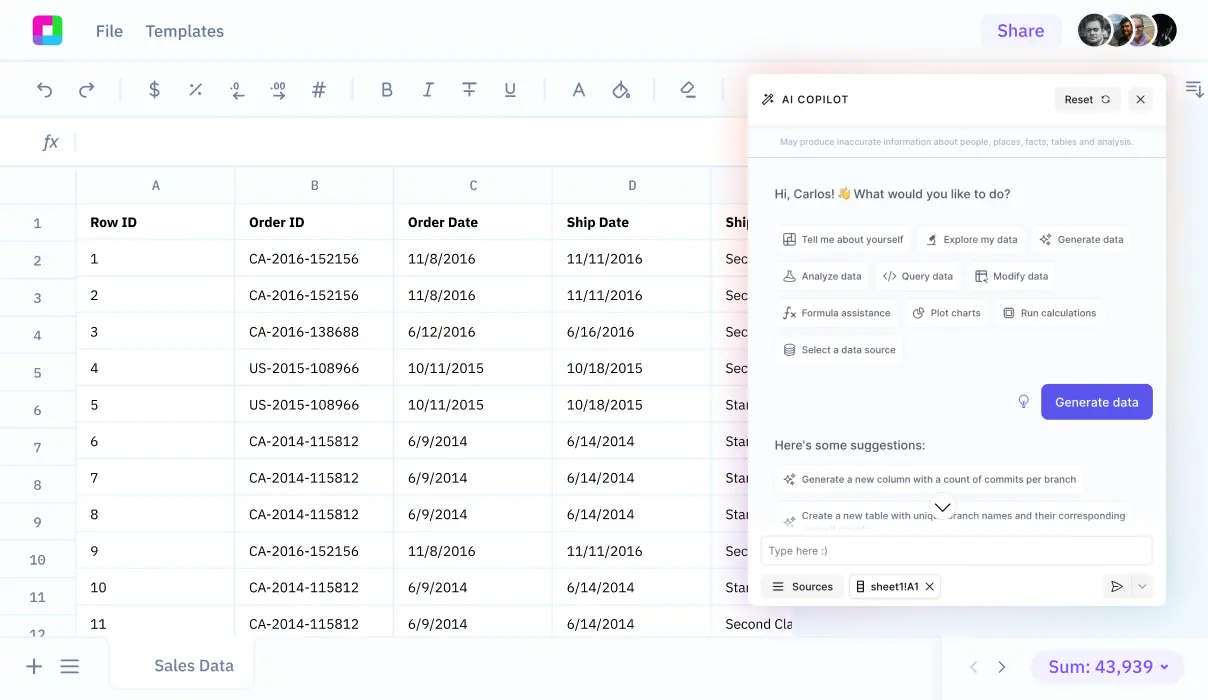
Unlock Clinical Insights from Healthcare Data
Healthcare data statistical analysis applies quantitative methods to patient information, clinical outcomes, and population health data to generate evidence-based insights. From evaluating treatment effectiveness to predicting patient risk factors, statistical analysis transforms raw medical data into knowledge that improves care quality and clinical decision-making.
Traditional healthcare analytics requires specialized statistical software, programming expertise, and weeks of data preparation. Researchers spend more time wrestling with R syntax or SAS procedures than interpreting results. This complexity creates barriers that slow research timelines and limit who can conduct meaningful analysis.
Sourcetable bridges this gap with AI-powered statistical analysis designed specifically for healthcare data. Maintain HIPAA compliance while performing sophisticated analyses—survival curves, multivariate regression, propensity score matching—using natural language queries. Researchers, clinicians, and healthcare administrators can now access the statistical rigor previously reserved for dedicated data scientists.
Why Healthcare Professionals Choose AI-Powered Statistical Analysis
Healthcare Professionals Choose AI-Powered Statistical Analysis
HIPAA-Compliant Security
All data processing meets HIPAA security standards with encryption at rest and in transit. Audit trails track data access and transformations, maintaining compliance for protected health information (PHI) throughout your analysis workflow.
No Programming Required
Perform complex statistical tests—Cox regression, Kaplan-Meier survival curves, propensity score matching—using plain English queries. AI translates your research questions into proper statistical methods without requiring R, Python, or SAS expertise.
Publication-Ready Results
Generate tables and figures formatted for medical journals. Output includes effect sizes, confidence intervals, p-values, and statistical test details ready for methods sections. Export to Word, LaTeX, or directly to manuscript templates.
Rapid Iteration and Hypothesis Testing
Test multiple hypotheses in minutes instead of days. Quickly explore relationships between variables, adjust for confounders, and run sensitivity analyses. Fast iteration accelerates discovery and strengthens research conclusions.
Healthcare Statistical Analysis Applications
Real-world applications and use cases
Clinical Trial Analysis
Analyze randomized controlled trial data with treatment vs. control comparisons, interim analyses, and safety monitoring. Perform intent-to-treat and per-protocol analyses, calculate number needed to treat, and generate CONSORT-compliant reporting.
Survival Analysis and Time-to-Event Studies
Examine patient outcomes over time using Kaplan-Meier curves, Cox proportional hazards regression, and competing risks analysis. Study mortality, disease recurrence, treatment duration, or any time-to-event outcome with censored data.
Epidemiological Research
Investigate disease patterns, risk factors, and protective factors in populations. Calculate incidence, prevalence, odds ratios, and relative risks. Control for confounding using stratification, multivariable adjustment, or propensity scores.
Healthcare Quality Improvement
Monitor quality metrics like readmission rates, hospital-acquired infections, or patient satisfaction. Use statistical process control charts to detect meaningful changes, benchmark performance, and evaluate intervention effectiveness.
Healthcare Statistical Analysis Workflow in Sourcetable
Step-by-step workflow guide
Import Healthcare Data Securely
Upload de-identified patient data from EHRs, research databases, or clinical trial systems. Sourcetable recognizes common medical data formats—ICD codes, lab values, medication lists—and structures them appropriately for analysis.
Define Your Research Question
Describe your analysis goal in plain language: 'Compare 30-day mortality between treatment groups adjusted for age and comorbidities' or 'Generate Kaplan-Meier curves stratified by disease stage.' AI determines appropriate statistical methods.
Data Preparation and Quality Checks
AI automatically handles missing data through appropriate imputation or exclusion, checks statistical assumptions, and flags potential issues. You maintain control over decisions while receiving expert guidance.
Run Statistical Analyses
Execute hypothesis tests, regression models, or machine learning algorithms. View results with proper statistical terminology, effect sizes, confidence intervals, and interpretation guidelines relevant to medical research.
Supported Healthcare Statistical Methods
Hypothesis Testing
Compare groups using appropriate tests: t-tests for continuous variables, chi-square for categorical outcomes, non-parametric alternatives when distributions violate assumptions. AI selects correct tests based on data characteristics and research design.
Regression Analysis
Model relationships between predictors and outcomes. Linear regression for continuous outcomes, logistic regression for binary outcomes, Poisson or negative binomial for count data. Adjust for confounding, test interactions, and report odds ratios or relative risks with confidence intervals.
Survival Analysis
Analyze time-to-event data with Kaplan-Meier estimators showing survival probability over time. Cox proportional hazards regression identifies prognostic factors while handling censored observations. Test proportional hazards assumptions and model time-varying covariates.
Longitudinal Data Analysis
Mixed-effects models account for repeated measurements on the same patients. Model within-person changes over time while adjusting for between-person differences. Handle missing data and irregular measurement intervals appropriately.
Propensity Score Methods
Control confounding in observational studies by balancing treatment groups on measured covariates. Generate propensity scores through logistic regression, then match patients, stratify, or use inverse probability weighting to estimate treatment effects.
Meta-Analysis
Combine results across multiple studies to estimate pooled effects. Calculate effect sizes from published data, assess heterogeneity, explore publication bias, and generate forest plots showing individual study results and summary estimates.
Diagnostic Test Analysis
Evaluate test performance with sensitivity, specificity, and predictive values. ROC curves compare tests and determine optimal cutoffs. Calculate likelihood ratios and diagnostic odds ratios. Model how test results change post-test probability using Bayes' theorem.
HIPAA Compliance and Data Security
Protected Health Information (PHI) Handling
Sourcetable implements technical safeguards required by HIPAA Security Rule. All PHI is encrypted using AES-256 during transmission and at rest. Access controls enforce minimum necessary principle, ensuring users only access data required for their role.
Audit Trails and Accountability
Comprehensive logging tracks all data access, analysis operations, and exports. Audit logs are tamper-proof and retained per regulatory requirements. Review trails demonstrate compliance during regulatory audits or breach investigations.
De-identification Support
Tools assist with HIPAA-compliant de-identification using Safe Harbor or Expert Determination methods. Automatically identify and remove or generalize direct identifiers. Generate limited datasets for research use in accordance with HIPAA Privacy Rule.
Business Associate Agreements
Sourcetable signs Business Associate Agreements (BAA) with covered entities and healthcare organizations. We maintain liability insurance and incident response procedures, accepting responsibility for safeguarding PHI as required by HIPAA.
IRB and Research Compliance
Features support Institutional Review Board (IRB) requirements for human subjects research. Version control documents analytical decisions, demonstrating research integrity. Export audit trails and analysis documentation for IRB submissions and reviews.
Frequently Asked Questions
Can I use Sourcetable for HIPAA-covered healthcare data?
Yes. Sourcetable provides HIPAA-compliant infrastructure with encryption, access controls, audit logging, and Business Associate Agreements. We implement technical, physical, and administrative safeguards required for protected health information. However, you remain responsible for ensuring data is appropriately de-identified or that you have proper authorization for PHI use.
Do I need statistical expertise to use Sourcetable for healthcare analysis?
While some statistical knowledge helps interpret results, you don't need programming skills or deep statistical training. Sourcetable's AI assists with method selection, assumption checking, and interpretation. For complex studies or when regulatory submission is planned, we recommend consulting with a biostatistician to review analytical approaches.
What statistical tests are supported for clinical research?
Sourcetable supports analyses commonly used in medical research: t-tests, ANOVA, chi-square, Fisher's exact test, linear and logistic regression, Cox regression, Kaplan-Meier survival analysis, mixed effects models, propensity score methods, meta-analysis, diagnostic test evaluation, and many others. The platform continues expanding statistical capabilities based on healthcare researcher needs.
Can I export results for regulatory submissions or publications?
Yes. Export analysis outputs in formats suitable for FDA submissions, journal manuscripts, or grant applications. Tables include proper statistical notation with effect sizes, confidence intervals, and p-values. Figures meet publication quality standards. Documentation describes methods used, enabling reproducibility required for regulatory review.
How does Sourcetable handle missing data in healthcare analyses?
AI identifies missing data patterns and recommends appropriate handling: complete case analysis, multiple imputation, inverse probability weighting, or sensitivity analyses. You control the approach while receiving guidance on implications for statistical validity and bias. Missing data handling is documented for transparency in research reporting.
Can I analyze multi-site clinical trial data?
Yes. Sourcetable handles multi-center trial data with site as a clustering variable or random effect. Perform stratified analyses, adjust for site in multivariable models, or use mixed effects models accounting for between-site variability. Generate site-specific reports while producing overall trial results.
Related Analysis Guides
Connect your most-used data sources and tools to Sourcetable for seamless analysis.



Frequently Asked Questions
If your question is not covered here, you can contact our team.
Contact UsHow do I analyze data?
What data sources are supported?
What data science tools are available?
Can I analyze spreadsheets with multiple tabs?
Can I generate data visualizations?
What is the maximum file size?
Is this free?
Is there a discount for students, professors, or teachers?
Is Sourcetable programmable?

Ready to Accelerate Healthcare Research?
Join researchers, clinicians, and healthcare organizations using AI-powered statistical analysis to generate clinical insights faster. Start analyzing healthcare data today.