

Master Sports Prediction with Bayesian Statistical Analysis
Harness the power of Bayesian inference to predict sports outcomes, analyze player performance, and build sophisticated forecasting models. Sourcetable combines advanced statistical methods with AI to transform raw sports data into actionable predictions.
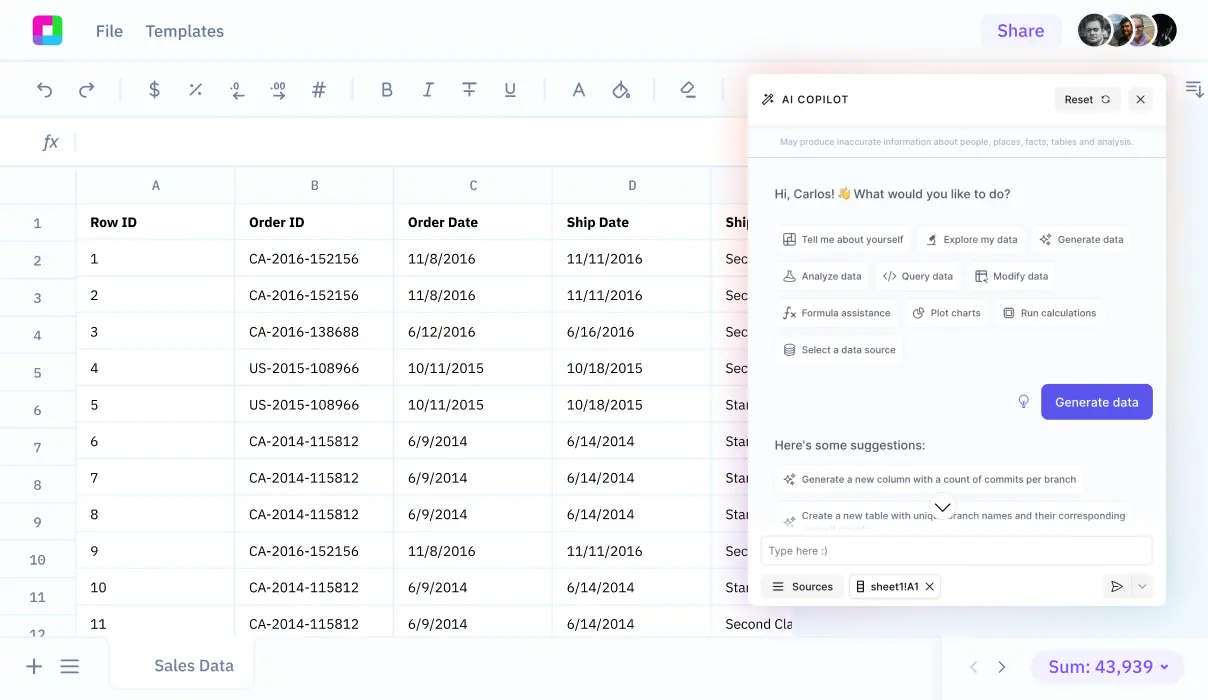
Transform Sports Data Into Winning Predictions
Bayesian sports prediction represents the cutting edge of statistical analysis in athletics. By incorporating prior knowledge, updating beliefs with new evidence, and quantifying uncertainty, Bayesian methods provide a mathematically rigorous framework for forecasting game outcomes, evaluating player performance, and identifying betting value.
Traditional frequentist statistics struggle with the dynamic, context-dependent nature of sports. Bayesian inference excels by continuously updating predictions as new data arrives—whether it's injury reports, weather conditions, or in-game events. This approach mirrors how expert analysts think about sports, making it both powerful and intuitive.
Sourcetable brings Bayesian sports analysis to everyone. Our AI-powered spreadsheet handles the complex mathematics behind posterior distributions, likelihood functions, and credible intervals—allowing you to focus on strategy rather than statistical theory. Whether you're a sports bettor, team analyst, or fantasy sports enthusiast, Bayesian methods can sharpen your predictions.
Why Use Bayesian Methods for Sports Prediction
Use Bayesian Methods for Sports Prediction
Incorporate Expert Knowledge
Bayesian analysis lets you encode domain expertise as prior distributions. Know that a team performs better at home? Build that belief into your model. The framework mathematically combines your knowledge with observed data.
Quantify Uncertainty
Every prediction comes with credible intervals showing the range of likely outcomes. Instead of a single point estimate, understand the full probability distribution. This is crucial for risk management in sports betting and decision-making.
Update Predictions in Real-Time
As new information arrives—lineup changes, weather updates, live game data—Bayesian models seamlessly incorporate it. Your predictions evolve dynamically, staying current with the latest developments.
Handle Small Sample Sizes
Traditional methods struggle with limited data. Bayesian approaches use priors to stabilize estimates when data is sparse, making them ideal for analyzing new players, rare matchups, or early-season performance.
Applications of Bayesian Sports Analysis
Real-world applications and use cases
Game Outcome Forecasting
Build win probability models that account for team strength, home advantage, rest days, and matchup history. Bayesian hierarchical models can share information across teams while respecting their unique characteristics.
Player Performance Projection
Predict individual player statistics using career trajectories, aging curves, and contextual factors. Bayesian methods handle the regression to the mean that plagues traditional projection systems.
Sports Betting Edge Detection
Compare your Bayesian predictions to betting market odds to identify value. Posterior distributions tell you not just expected value, but also the confidence you should have in each bet.
Fantasy Sports Optimization
Project player point distributions for daily fantasy sports. Bayesian analysis helps you understand upside scenarios, floor outcomes, and optimal lineup construction under uncertainty.
Bayesian Sports Prediction Workflow in Sourcetable
Step-by-step workflow guide
Import Sports Data
Connect to sports databases, APIs, or upload CSV files with game results, player statistics, and contextual variables. Sourcetable handles data from all major sports and leagues.
Define Prior Distributions
Specify your initial beliefs about parameters. Use weakly informative priors for general analysis, or encode strong domain knowledge. Our AI assistant helps translate intuitions into mathematical priors.
Specify Likelihood Models
Choose appropriate probability distributions for your data. Common choices include normal distributions for continuous stats, Poisson for scoring, and binomial for win/loss outcomes.
Run Bayesian Inference
Sourcetable's computational engine performs Markov Chain Monte Carlo (MCMC) sampling or variational inference to derive posterior distributions. Complex calculations happen automatically.
Core Bayesian Concepts for Sports Analysis
Bayes' Theorem
At the heart of Bayesian analysis is Bayes' Theorem: P(hypothesis|data) = P(data|hypothesis) × P(hypothesis) / P(data). In sports terms, this updates your belief about a team's true strength (hypothesis) based on observed game results (data).
Prior Distributions
Priors represent your beliefs before seeing data. For a new season, you might use last year's team ratings as priors. For a rookie player, you might use college statistics or comparable player trajectories. The key is making priors explicit and defensible.
Likelihood Functions
The likelihood quantifies how probable your observed data is under different parameter values. For game scores, you might use a Poisson distribution. For shooting percentages, a beta-binomial model. Choosing the right likelihood is crucial for accurate inference.
Posterior Distributions
The posterior combines your prior beliefs with observed data, representing your updated knowledge. It's a full probability distribution, not a single number—capturing both your best estimate and your uncertainty about it.
Credible Intervals
A 95% credible interval means there's a 95% probability the true parameter lies within that range (given your model and data). Unlike frequentist confidence intervals, credible intervals have the intuitive interpretation that most people expect.
Posterior Predictive Distributions
These distributions represent predictions for future observations, integrating over parameter uncertainty. Instead of predicting a team will score exactly 24 points, you get a distribution showing they'll likely score between 17-31 with 90% probability.
Advanced Bayesian Sports Modeling
Hierarchical Models
Hierarchical (multilevel) models are perfect for sports data with natural groupings. Model players within teams, or teams within conferences. Lower levels borrow statistical strength from upper levels, improving estimates for entities with limited data.
Time-Varying Parameters
Team and player abilities change over time due to injuries, trades, development, and aging. Dynamic Bayesian models allow parameters to evolve across the season, automatically detecting when a team gets hot or a player enters a slump.
Bayesian Model Averaging
Instead of choosing one model, combine predictions from multiple models weighted by their posterior probabilities. This accounts for model uncertainty and often outperforms single-model approaches in out-of-sample testing.
Skill vs. Luck Decomposition
Bayesian variance decomposition separates observed performance into skill components (repeatable ability) and luck components (random variation). This is crucial for distinguishing genuine team improvement from regression to the mean.
Prior Sensitivity Analysis
Test how your conclusions change with different prior specifications. Robust results that hold across reasonable priors are more trustworthy than those highly sensitive to prior choice.
Model Checking and Validation
Use posterior predictive checks to assess model fit. Simulate data from your fitted model and compare to actual observations. Good models generate data that looks like reality. Track out-of-sample prediction accuracy to avoid overfitting.
Real-World Bayesian Sports Analysis Examples
Example 1: NBA Win Probability Model
Build a Bradley-Terry model to estimate team strengths. Start with last season's ratings as priors, then update with current season results. The posterior gives you strength ratings with uncertainty—teams with fewer games have wider credible intervals. Compare your win probabilities to betting lines to find value.
Example 2: MLB Player Projection System
Project batting averages using a beta-binomial model. The prior comes from league average and player history. After each at-bat, update the posterior. Early season predictions lean heavily on priors (career stats), but as the season progresses, current performance weighs more heavily.
Example 3: NFL Point Spread Predictions
Use a hierarchical linear model where team offensive and defensive strengths are parameters. Include home field advantage and rest effects. The model shares information across teams while respecting their uniqueness. Posterior predictive distributions give you point spread estimates with confidence bands.
Example 4: Soccer Goal Expectation Models
Model goals scored as independent Poisson processes for each team. Team attack and defense strengths are parameters estimated from historical results. The Poisson assumption captures the discrete, rare-event nature of soccer scoring. Predictions include not just expected goals, but full probability distributions over possible scorelines.
Example 5: Fantasy Sports Upside Analysis
For daily fantasy sports tournaments, you care about upside (the 90th percentile outcome) not just expected value. Bayesian models give you the full posterior predictive distribution, letting you quantify and compare player ceilings. Optimize lineups to maximize probability of high finishes, not just expected points.
Frequently Asked Questions
Do I need to know advanced statistics to use Bayesian sports prediction?
No. Sourcetable's AI assistant translates natural language questions into proper Bayesian analyses. You can say 'predict next week's game outcomes with uncertainty' and the system builds and runs the appropriate model. However, understanding core concepts helps you interpret results and make better modeling decisions.
How do I choose appropriate prior distributions?
Start with weakly informative priors that constrain parameters to reasonable ranges without being too specific. For team ratings, use last season's results or league-average performance. For new players, use comparable player statistics or position averages. Sourcetable provides prior templates for common sports analytics scenarios.
Can Bayesian methods beat betting markets consistently?
Betting markets are highly efficient, so beating them consistently is difficult. However, Bayesian analysis helps you find spots where your model disagrees with market odds. Focus on less-efficient markets (smaller sports, props, live betting) where information advantages matter more. Proper bankroll management and bet sizing based on your confidence levels (from posterior distributions) is crucial.
How often should I update my Bayesian sports models?
Update whenever new relevant information arrives. For season-long predictions, update after each game. For in-game win probability, update after each possession or scoring event. Bayesian updating is computationally efficient—you don't need to refit from scratch, just apply Bayes' rule to incorporate new data.
What's the difference between Bayesian and machine learning approaches for sports prediction?
Machine learning (especially neural networks) excels at finding complex patterns in large datasets but provides point predictions without well-calibrated uncertainty. Bayesian methods excel at quantifying uncertainty, incorporating domain knowledge, and working with smaller datasets. The best approach often combines both: use ML for feature engineering and Bayesian methods for final predictions with uncertainty.
How do I validate that my Bayesian sports model is working well?
Use proper scoring rules like log probability to evaluate probabilistic predictions. Track calibration: do events you predict with 70% probability actually occur 70% of the time? Compare out-of-sample prediction accuracy to benchmarks and betting market prices. Run posterior predictive checks to ensure simulated data from your model resembles actual sports outcomes.
Related Analysis Guides
Connect your most-used data sources and tools to Sourcetable for seamless analysis.




Frequently Asked Questions
If your question is not covered here, you can contact our team.
Contact UsHow do I analyze data?
What data sources are supported?
What data science tools are available?
Can I analyze spreadsheets with multiple tabs?
Can I generate data visualizations?
What is the maximum file size?
Is this free?
Is there a discount for students, professors, or teachers?
Is Sourcetable programmable?

Ready to Master Sports Prediction?
Join analysts, bettors, and sports professionals using Bayesian methods to gain competitive edges. Start analyzing sports data with AI today.