

Cluster Analysis
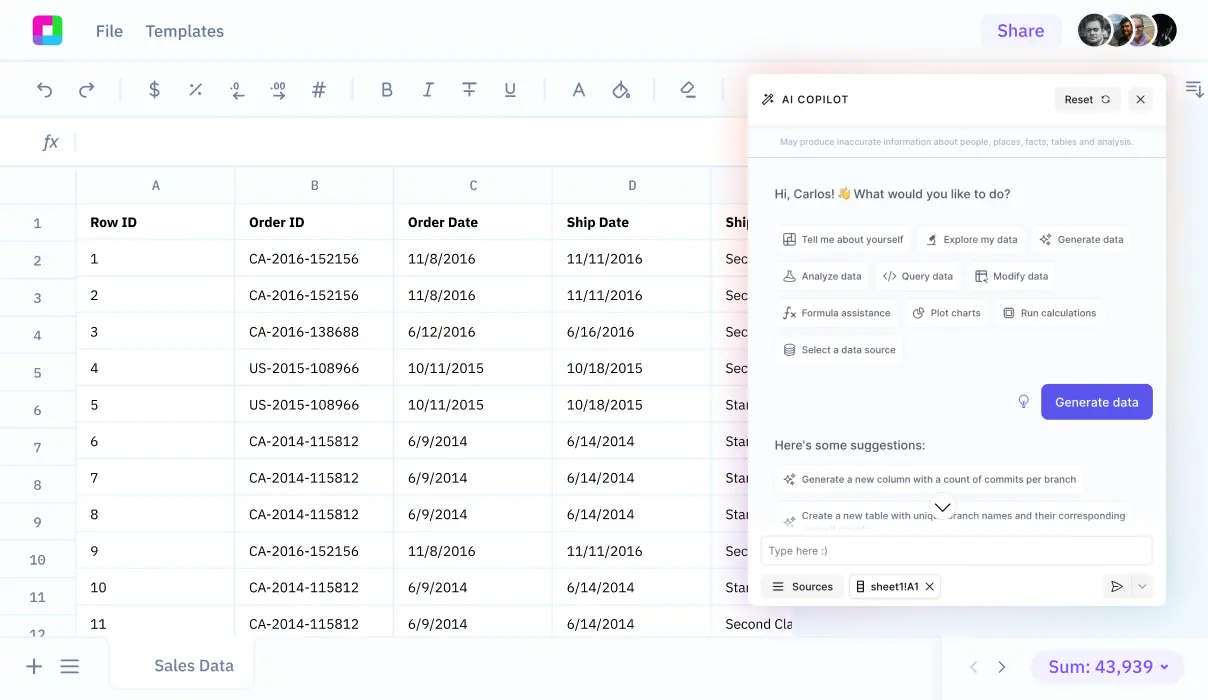
Analyze any type of data with Sourcetable. Talk to Sourcetable's AI chatbot to tell it what analysis you want to run, and watch Sourcetable do the rest.
Introduction
Cluster Analysis is a statistical technique that groups similar data points into clusters, revealing patterns and relationships within datasets. Traditional methods involve using Excel's scatter graphs, random starting points, and sum of squares calculations to identify clusters. While Excel requires manual steps like using IF statements and calculating means with average functions, modern AI alternatives streamline this process. Sourcetable, an AI-powered spreadsheet, transforms how we analyze data by letting you simply tell its AI chatbot what analysis you need. Rather than wrestling with Excel functions, you can upload any size file or connect your database and let Sourcetable's AI generate insights, create visualizations, and perform cluster analysis automatically. Learn how to perform efficient Cluster Analysis with Sourcetable at sourcetable.com/signup.

Why Sourcetable Is Superior for Cluster Analysis
Sourcetable revolutionizes cluster analysis by replacing Excel's complex functions with an intuitive AI chatbot interface. While Excel requires templates and manual processing for clustering, Sourcetable lets you simply describe your analysis needs in plain language and automatically delivers results.
Advanced Data Processing
Sourcetable's cloud-based architecture handles datasets of any size that would overwhelm Excel. Whether you're uploading CSV files or connecting to databases, Sourcetable processes complex clustering tasks effortlessly.
AI-Powered Analysis
Unlike Excel's basic clustering template, Sourcetable's AI chatbot guides you through sophisticated cluster analysis without requiring technical expertise. Simply describe what insights you're seeking, and Sourcetable's AI will analyze patterns, determine optimal cluster numbers, and interpret results.
Natural Language Interface
Sourcetable eliminates the need to learn complex Excel functions or clustering algorithms. Users communicate their analysis requirements conversationally, and the AI generates appropriate visualizations, charts, and insights automatically.
Automated Reporting
Sourcetable automates the entire clustering workflow from data preparation to visualization and reporting. This automation eliminates the manual effort required in Excel, allowing analysts to focus on understanding insights rather than wrestling with spreadsheet functions.
Try Sourcetable For Free
Analyze anything with Sourcetable AI. Tell Sourcetable's AI spreadsheet what to analyze. Watch Sourcetable do the rest.
Try for free
Benefits of Cluster Analysis with Sourcetable vs Excel
Why Use Cluster Analysis
Cluster analysis reveals hidden patterns and relationships in large datasets, providing deeper insights into data structure. This analytical method reduces dataset complexity, making interpretation more manageable. The resulting data visualizations offer powerful tools for communicating complex information in an easily understandable format.
Advantages of Sourcetable for Cluster Analysis
Sourcetable's AI-powered interface revolutionizes cluster analysis by allowing users to communicate their analytical needs through natural language instead of complex Excel functions. While Excel requires manual structuring of source data and creation of separate summary tables, Sourcetable's AI chatbot automates the entire process through simple conversation.
Unlike Excel's size limitations, Sourcetable efficiently handles data files of any size and connects directly to databases. The AI assistant guides users through the cluster analysis process, from data preparation to visualization, eliminating the need for manual function inputs or formula creation.
The AI engine minimizes human error and improves data-driven decision-making through automated pattern recognition and cluster visualization. Users simply describe their analysis goals to Sourcetable's AI, which then generates appropriate visualizations and insights, making complex cluster analysis accessible to users of all skill levels.
Types of Cluster Analysis in Sourcetable
Sourcetable's AI-powered spreadsheet platform simplifies cluster analysis through natural language interactions. Instead of manually configuring complex algorithms, users can simply tell Sourcetable's AI chatbot what patterns they want to find in their data, whether from uploaded files or connected databases.
Conversational Clustering
Users can request hierarchical, k-means, model-based, or density-based clustering analyses through natural language commands. Sourcetable's AI interprets these requests and automatically applies the appropriate clustering method to identify patterns in the data.
AI-Guided Analysis
Rather than manually determining parameters like optimal cluster numbers, Sourcetable's AI assistant guides users through the analysis process. The AI can suggest the best clustering approach based on the data structure and analysis goals.
Automated Visualization
Sourcetable automatically generates clear visualizations of clustering results through conversational requests. Users can ask the AI to create dendrograms, scatter plots, or other visual representations to better understand their data clusters.
Applications
This AI-driven approach to clustering supports various applications, from market segmentation to scientific research, making complex data analysis accessible through simple conversations with Sourcetable's AI assistant.
Sourcetable Cluster Analysis Use Cases
Customer Segmentation Analysis |
Upload customer datasets and use Sourcetable's AI to automatically identify distinct customer segments. Simply ask the AI to group customers based on purchasing patterns, preferences, and demographics for targeted marketing strategies. |
Healthcare Pattern Recognition |
Connect healthcare databases to Sourcetable and use natural language commands to cluster patient data into meaningful subgroups. Identify treatment response patterns and health outcomes through AI-powered analysis. |
Financial Anomaly Detection |
Upload financial transaction data and let Sourcetable's AI identify suspicious patterns through cluster analysis. Use conversational commands to detect unusual activities and potential fraud cases in large datasets. |
Market Research Segmentation |
Import market research data and ask Sourcetable's AI to perform cluster analysis for identifying market segments. Generate visualizations and insights through natural language requests without complex spreadsheet formulas. |
Frequently Asked Questions
What is Cluster Analysis and why is it useful?
Cluster Analysis is a statistical technique that uses algorithms to group similar data points together, revealing patterns and structures within datasets. It's particularly useful for tasks like customer segmentation, disease pattern identification, social network analysis, and market research by identifying meaningful relationships and associations within complex data.
What are the main applications of Cluster Analysis?
The main applications include market segmentation based on customer buying behavior, healthcare applications for disease management and patient grouping, social media analysis for user engagement and content personalization, and city planning for resource allocation. It's also used in biology for genetic research and conservation efforts.
How can I perform Cluster Analysis in Sourcetable?
With Sourcetable, you can easily perform cluster analysis by simply uploading your data file or connecting your database, then telling the AI chatbot what kind of analysis you want to perform. The AI will handle the technical aspects and can create various visualizations like scatterplots, heatmaps, or dendrograms to help you understand your clusters. You don't need to know complex functions or coding - just describe what you want to analyze in natural language, and Sourcetable's AI will do the rest.
Conclusion
Cluster Analysis in Excel requires complex calculations and manual data manipulation. The process involves calculating distances between points, updating cluster centers, and repeating iterations until convergence. Research shows model-based methods like K-prototypes and LCM outperform traditional distance-based clustering approaches.
Modern alternatives like Sourcetable eliminate the need for complex Excel formulas and manual analysis. Simply upload your data and tell Sourcetable's AI chatbot what analysis you want to perform. The AI handles all calculations, visualization, and interpretation, making advanced clustering techniques accessible to everyone - no Excel expertise required.
Ready to try AI-powered Cluster Analysis? Sign up for Sourcetable to experience how conversational AI transforms spreadsheet analytics.
Try Sourcetable For Free
Analyze anything with Sourcetable AI. Tell Sourcetable's AI spreadsheet what to analyze. Watch Sourcetable do the rest.
Try for free
Recommended Analysis Guides
Connect your most-used data sources and tools to Sourcetable for seamless analysis.


Frequently Asked Questions
If your question is not covered here, you can contact our team.
Contact UsHow do I analyze data?
What data sources are supported?
What data science tools are available?
Can I analyze spreadsheets with multiple tabs?
Can I generate data visualizations?
What is the maximum file size?
Is this free?
Is there a discount for students, professors, or teachers?
Is Sourcetable programmable?

Analyze Anything With AI
Tell Sourcetable's Al spreadsheet what analysis you want to run, and watch it run. Sign up to get started for free.